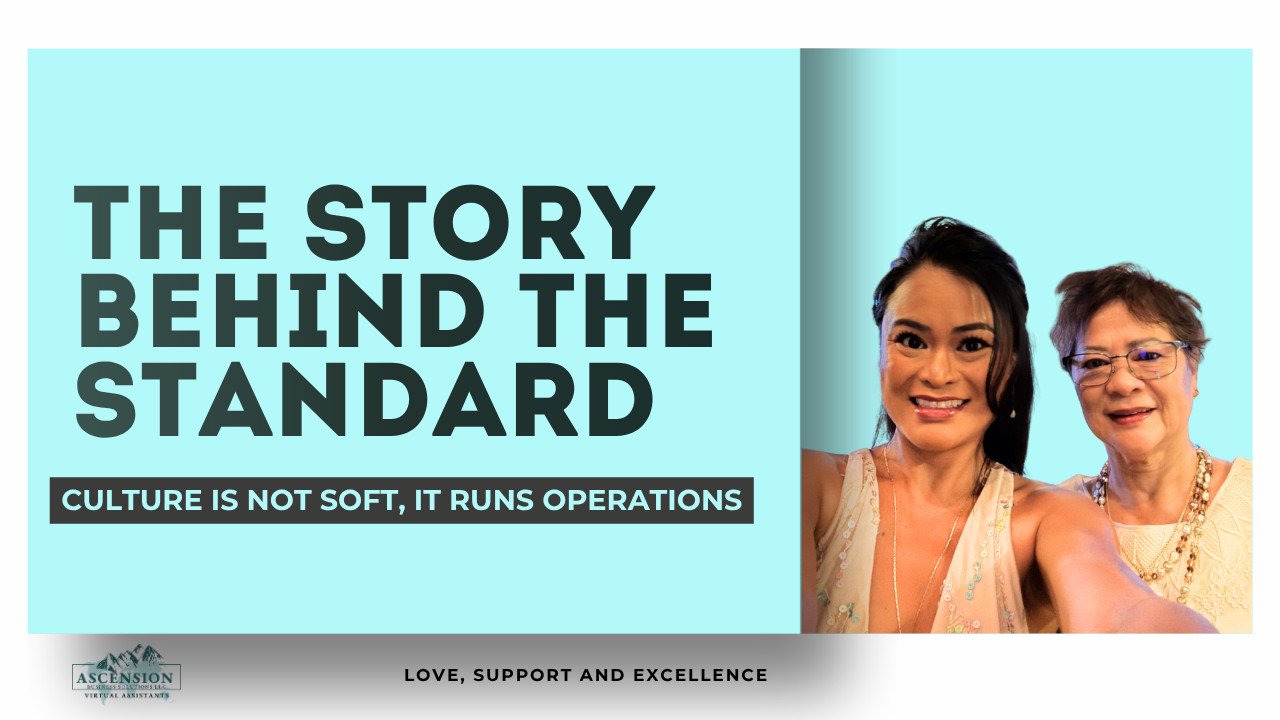
Before Ascension Business Solutions became a support partner for home care and home health leaders, there was a story behind the standard.

Regina Asuncion, CEO of ABS, often traces part of her leadership foundation back to her mother, Rita Asuncion: an immigrant nurse who built a home health agency in Colorado. That story shaped something deeper than business knowledge. It shaped the way ABS thinks about care, responsibility, preparation, humility, and character. At ABS, those values are carried through Love, Support, and Excellence.
And if you own or operate a home care agency, you already know this truth:
The work is never just about tasks.
It is about people. It is about trust. It is about how quickly your team responds when a caregiver calls off, how clearly someone documents an update, how calmly your team communicates with a concerned family, and how consistently your agency protects the flow of care when pressure rises.
That is why culture is not soft.
Culture is operational.
When Your Agency Is Under Pressure, Culture Becomes Visible
Most home care and home health leaders do not wake up thinking, “I need better culture.”
They think:
- Why is scheduling still falling back on me?
- Why are caregiver follow-ups not moving fast enough?
- Why is intake taking too long?
- Why are after-hours calls creating stress every weekend?
- Why am I still the backup plan for every operational gap?
The pain does not always come from one major failure. It usually comes from small breakdowns that keep repeating: missed handoffs, delayed updates, unclear documentation, slow follow-through, poor responsiveness, or team members who wait too long to ask for help.
In healthcare settings, communication is not a “nice-to-have.” The Agency for Healthcare Research and Quality states that effective communication plays an integral role in delivering high-quality, patient-centered care, and that barriers to teamwork and communication influence team outcomes. AHRQ also connects communication errors with patient care delivery.
That matters inside your agency.
Because when communication breaks down, the owner often becomes the safety net.
You step in.
You check the schedule.
- You follow up with the caregiver.
- You reassure the family.
- You ask for the missing update.
- You fix what should have been handled before it reached your desk.
That is not sustainable leadership.
That is operational overload.
The Real Question Is Not “Can Someone Do the Task?”
When home care owners think about hiring support, the first question is often task-based.
- Can someone help with scheduling?
- Can someone help with recruiting?
- Can someone help with intake?
- Can someone answer after-hours calls?
- Can someone manage admin follow-up?
Those are important questions.
But they are not the most important question.
The better question is:
Can this person carry responsibility with the right communication, coachability, urgency, and care?
Because in home care operations, the wrong support can create more work. A person may know the task but still lack the judgment, consistency, or communication rhythm needed to protect your agency from more interruptions.
The right support does not just complete work.
The right support reduces pressure.
That is why ABS positions operational support as more than VA placement. ABS is built to help home care and healthcare leaders create a support structure that strengthens care delivery, reduces owner bottlenecks, and builds stronger operational capacity.
This is where culture becomes part of the support system.
What Culture Looks Like in Daily Home Care Operations
Culture is not just team bonding.
It is how someone communicates when a shift changes at the last minute.
It is how someone responds when a caregiver is frustrated.
It is how someone handles a family member who needs reassurance.
It is how someone receives correction after a missed detail.
It is how someone documents the update before the next person has to ask.
It is how someone escalates instead of guessing.
Culture becomes visible in the small decisions that protect or weaken your agency’s daily flow.
AHRQ’s TeamSTEPPS program is built around improving communication and teamwork skills to optimize patient outcomes, which reinforces a very practical point for care-based organizations: strong teams do not happen by accident. They are trained around communication, mutual support, leadership, and shared awareness.
For a home care agency, that translates into something very real:
- A scheduler needs urgency.
- A recruiter needs follow-through.
- An intake coordinator needs accuracy.
- An after-hours support person needs calm judgment.
- An admin VA needs consistency.
- A support team needs the confidence to ask questions early, not after the mistake grows.
That is culture in action.
Why Filipino Virtual Assistants Are a Strong Fit for Home Care Support
The Filipino workforce has a long and credible connection to care-based industries, especially healthcare.
The Migration Policy Institute reported that nearly 2.8 million immigrants worked in the U.S. healthcare sector in 2021, representing more than 18% of the U.S. healthcare workforce. MPI also found that foreign-born workers were especially represented among home health aides, making up almost 40% of that occupation.
The Filipino connection is especially strong in nursing. MPI reported that immigrants from the Philippines accounted for 27% of foreign-born registered nurses in the United States in 2021. Another MPI analysis notes that the Philippines has long been the source of the most migrant nurses, with many Filipino nurses destined for the United States.
This does not mean every Filipino professional is automatically the right fit for every support role.
That would be too broad.
The real advantage is this: the Philippines offers a strong foundation of care-centered values, English communication, global service experience, and familiarity with healthcare-adjacent work. When that foundation is paired with ABS training, coaching, quality standards, and client alignment, it becomes a meaningful edge for home care and home health support.
Care Is Cultural Before It Becomes Operational
Home care is personal. Families are trusting your agency with someone they love. Caregivers are trusting your team for clarity, scheduling, and communication. Owners are trusting their support staff to protect the standard of service when they are not in every conversation.
This is one reason Filipino culture connects naturally with care-based work.
Acta Medica Philippina notes that in the Philippines, family is traditionally the main caregiver for elderly parents and adults, shaped by Filipino filial piety and respectful behavior toward older people.
That matters because home care is not just logistics.
- It is reassurance.
- It is patience.
- It is respect.
- It is follow-through.
It is understanding that behind every schedule, every call, and every update, there is a client, a caregiver, a family, and a leader depending on the work being done well.
This is where Filipino virtual assistant support can become powerful for home care agencies, especially when the provider understands the industry and does not treat the role as generic admin work.
At ABS, we do not believe support should feel disconnected from the mission of care.
We support the people who support care.
Why English Communication and Healthcare Outsourcing Matter
For U.S.-based home care and home health agencies, communication matters. Your support team needs to understand instructions, ask clear questions, document properly, and communicate professionally with U.S.-based teams.
The Philippines has a strong foundation for this. Executive Order No. 210 cites the Philippine Constitution’s provision that Filipino and English are official languages for communication and instruction. The order also emphasized strengthening English proficiency to support competitiveness in fast-growing industries, including information and communications technology.
The country also has a developed outsourcing ecosystem, including healthcare support. The Healthcare Information Management Association of the Philippines represents the Philippine healthcare information management sector globally and markets the Philippines as a preferred outsourcing destination for healthcare IT-BPM.
For home care agencies, this matters because back-office support is no longer just “admin help.”
You need people who can work inside healthcare-adjacent workflows, communicate with professionalism, understand urgency, adapt to tools, follow documentation standards, and support the daily rhythm of care operations.
That is why Filipino virtual assistants for healthcare and home care back-office support can be a strong fit when they are properly selected, trained, and aligned.
But Culture Alone Is Not Enough
This is where ABS draws an important line.
Warmth is not enough.
- A helpful attitude is not enough.
- English proficiency is not enough.
- A willingness to work is not enough.
Home care support requires structure.
Your agency needs support that understands expectations before the work begins. That includes role clarity, communication standards, training, coaching, feedback, documentation habits, escalation expectations, and alignment with your agency’s workflow.
This is why ABS does not simply provide “a VA.”
ABS prepares support around the pressure points that home care and home health leaders actually face: scheduling, recruiting, intake, after-hours coverage, caregiver coordination, documentation, admin support, and leadership bottlenecks.
Before support begins, the goal is not just to place a person.
The goal is to understand where your agency is carrying too much pressure and build the right support structure around it.
What ABS Prepares Before Support Begins
A strong support system should not make you feel like you have one more person to manage.
It should create more clarity.
At ABS, preparation matters because your agency does not have time for guesswork. The support process is designed around understanding what kind of help your agency needs, what expectations should be clear from the beginning, and how the support person should communicate, document, and improve.
That preparation may include:
- Role-based matching based on the agency’s operational needs
- Home-care-focused training and expectations
- Structured onboarding and communication alignment
- Clear documentation and handoff standards
- Coaching and feedback support
- Success support to help the placement stabilize
- Service categories built around real agency pressure points, including scheduling, recruiting, intake, after-hours, admin, and executive support
This is the difference between filling a seat and strengthening an operation.
Generic support may give you more hands.
Prepared support gives you more capacity.
Why Psychological Safety Matters in Home Care Support Teams
Another important part of culture is whether people feel safe enough to speak up.
This matters because a VA who is afraid to ask questions may stay silent. A scheduler who is not coached well may hide confusion. A recruiter who does not know how to receive feedback may repeat the same mistake. An after-hours support person who does not understand escalation may delay the handoff your team needed earlier.
Harvard T.H. Chan School of Public Health reported that psychological safety is essential to employee wellbeing and retention, especially during times of crisis. Harvard Business School also describes psychological safety as a work environment where candor is expected and employees can speak up without fear of retribution.
For home care support, this is not theory.
It is practical.
Your support team needs to know when to ask, when to escalate, when to clarify, and when to own the mistake and improve. Culture gives them the environment to do that. Standards give them the structure to do it well.
Strong support needs both.
Why This Matters for Home Care and Home Health Leaders
If you are leading a home care or home health agency, you are not just managing tasks.
You are protecting care continuity.
Every scheduling gap affects the client experience.
Every recruiting delay affects growth.
Every slow intake follow-up affects opportunity.
Every after-hours miss affects trust.
Every unclear handoff creates more work for your internal team.
Every operational bottleneck pulls leadership away from growth.
This is why the right support system matters.
Not because your agency needs “more help.”
Because your agency needs the right help in the right places, with the right communication habits, the right training, and the right culture behind it.
That is what ABS means by the right who.
The right who is not just someone available to work.
The right who is someone prepared to support your agency with care, clarity, coachability, and consistency.
Why Home Care Leaders Can Trust ABS
Trust is built when a support partner understands your world.
ABS is focused on home care, home health, hospice, senior care, and healthcare operations. That matters because your agency does not need someone learning from scratch what operational pressure feels like in care-based work.
You need a partner who understands that scheduling is not just a calendar.
It is care continuity.
Recruiting is not just candidate outreach.
It is growth capacity.
After-hours is not just answering calls.
It is protecting trust when your internal team is offline.
Intake is not just paperwork.
It is the front door of your agency.
Admin support is not just task completion.
It is removing the small operational weights that keep leadership stuck in the weeds.
ABS is built around that understanding. The company’s positioning is clear: operational support that strengthens care delivery, reduces owner bottlenecks, and builds stronger operational capacity.
That is why culture matters.
Because the support person inside your agency is not just representing ABS.
They are touching the rhythm of your business.
Strong Culture Creates Stronger Service
Culture is not what a team says on a good day.
Culture is how people communicate when the schedule changes.
- It is how they respond when a caregiver calls off.
- It is how they follow through when a family needs reassurance.
- It is how they document when the next person depends on the update.
- It is how they receive feedback when something needs to improve.
For home care and home health agencies, culture is not soft.
Culture is part of the support system.
And when the right culture is paired with the right training, the right coaching, the right standards, and the right alignment, support becomes more than task completion.
It becomes capacity.
It becomes consistency.
It becomes room for leadership to lead again.
If scheduling, recruiting, intake, after-hours coverage, or daily administrative follow-up is starting to pull your leadership team away from growth, ABS can help you identify the right support structure for your agency.
Because stronger support starts with the right who.
And the right who can change how your agency operates, grows, and serves.
Ready to build stronger support behind your home care operations? Connect with ABS and discover how the right who can bring more clarity, consistency, and capacity to your agency.
Connect with ABS
Sources & Further Reading
This article is supported by healthcare, workforce, and culture research from trusted sources including AHRQ, Migration Policy Institute, Harvard, Acta Medica Philippina, and Philippine healthcare outsourcing organizations.
- Agency for Healthcare Research and Quality — Implement Teamwork and Communication
- AHRQ — TeamSTEPPS Program
- Migration Policy Institute — Immigrant Health-Care Workers in the United States
- Migration Policy Institute — Aging Societies Rely on Immigrant Health-Care Workers
- Acta Medica Philippina — Caring Behavior of Filipinos Toward Elderly Family Members
- Philippine Executive Order No. 210 — English Language Instruction
- Healthcare Information Management Association of the Philippines
- Harvard T.H. Chan School of Public Health — Psychological Safety at Work
- Harvard Business School — Psychological Safety and High-Performing Teams