
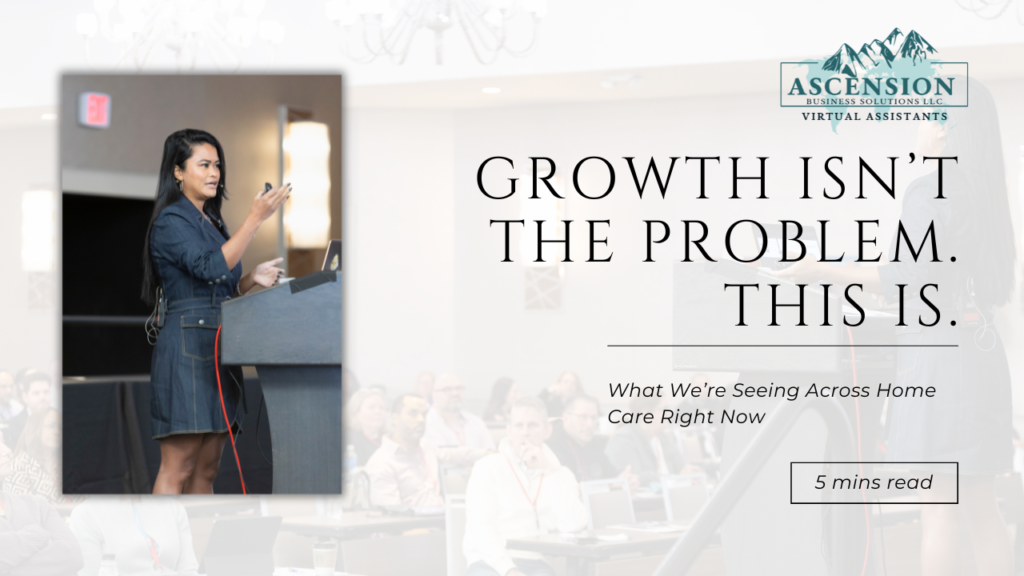
Where Real Growth Conversations Actually Happen
Over the past few weeks, we’ve been in rooms with home care and home health owners across the country.
Not behind screens.
Not in theory.
In real conversations—at conferences, private events, and one-on-one discussions with operators actively building, struggling, and scaling.
We’re talking about:
- Owners running multi-location agencies (5–10+)
- Organizations doing $2M–$10M+ in revenue
- Teams where schedulers are managing 80–120+ caregivers and clinicians
And when you step into enough of these rooms, patterns become impossible to ignore.
This is not a highlight reel.
This is what’s actually happening inside care-based organizations right now.
And if you’re already in this space—whether as an owner, operator, or current partner—this will likely feel familiar.
What We’re Hearing—Over and Over Again
Across different brands, markets, and agency sizes (home care and home health), the same core issues continue to surface:
1. Recruiting Isn’t the Real Problem
Most organizations believe their biggest challenge is hiring.
But what we’re seeing is different.
It’s not about finding people—it’s about:
- Filtering the right candidates
- Setting clear expectations
- Defining what “ready” actually means
Without that, hiring faster just creates faster turnover.
👉 For current clients:
Even with support in place, if internal expectations and role clarity aren’t aligned, performance gaps will still show up.
2. Scheduling Pressure Is Unsustainable
Schedulers are overwhelmed.
Owners or admins are still stepping in.
Operations rely heavily on reactive decision-making.
What looks like a “people problem” is often:
- Lack of structure
- No clear escalation pathways
- No defined ownership
So the pressure never leaves—it just shifts—from team to leadership.
👉 For both clients and prospects:
Support roles alone don’t remove pressure—structure does.
3. Training Is Inconsistent
There is no universal definition of readiness.
What we’re seeing:
- Training varies by branch, office, or leader
- No standardized benchmarks
- Performance gaps showing up after placement—not before
Which leads to:
👉 Constant correction instead of confident execution
👉 For current clients:
The difference between a performing team and a struggling one is rarely effort—it’s clarity in training expectations and feedback loops.
4. Leadership Becomes the Bottleneck
This shows up in almost every conversation.
Owners, directors, and administrators are:
- The decision-makers
- The fallback
- The safety net
And while that works early on—it doesn’t scale.
When everything flows through one person, growth slows down—even when demand is there.
👉 For scaling agencies:
If your team still depends on you to function daily, you don’t have leverage yet—you have dependency.
What This Actually Means (This Is the Part Most People Miss)
These are not isolated problems.
They are symptoms.
Symptoms of something deeper:
👉 Operational Misalignment
- Hiring without defined standards
- Training without measurable readiness
- Roles without clear structure
- Systems that rely on people instead of supporting them
So when organizations grow, the cracks don’t disappear.
They widen.
What This Looks Like If Nothing Changes
This is where most agencies and providers underestimate the impact.
If these patterns continue:
- More hires → more turnover, not stability
- More patients/clients → declining service quality
- More revenue → more internal strain and inefficiencies
- More owner involvement → burnout, not scalability
Growth starts to feel heavier instead of more controlled.
And eventually, organizations hit a ceiling—not because demand isn’t there,
but because the operation can’t support it.
The Shift: Understanding the “Capacity Gap”
One of the biggest misconceptions we hear:
“If we just hire more people, things will stabilize.”
But what we’re seeing tells a different story.
👉 The Capacity Gap
The space between:
- The volume you’re trying to handle
- And the structure you actually have in place to support it
Growth doesn’t break organizations.
Lack of operational capacity does.
Adding more people into a misaligned system doesn’t fix the issue—it amplifies it.
Because:
- More people = more coordination
- More coordination = more complexity
- More complexity = more reliance on leadership
Without structure, growth creates pressure—not progress.
👉 This applies whether you have 0 support—or a full team already in place.
What Stronger Operators (and Smarter Partners) Are Starting to Realize
The conversations are shifting.
More owners and leaders are beginning to ask:
- “Do we actually have the right structure in place?”
- “Are our roles clearly defined—or constantly overlapping?”
- “Is our support team set up for success—or just filling gaps?”
- “Are we building something that can operate without us?”
And that’s where the real growth conversations are happening.
Not on stage.
Not in presentations.
But in smaller rooms—where operators speak honestly about what’s working and what’s not.
Why This Matters Right Now
This moment in home care and home health is different.
Demand is there.
Opportunities are there.
But the organizations that will sustain growth are not the ones moving fastest.
They’re the ones building:
- Clarity in roles
- Consistency in training
- Structure in operations
- Accountability across teams
Because scale isn’t just about adding volume.
It’s about supporting it—intentionally.
From the Field—Not From Assumptions
Everything in this article comes from real conversations.
Across:
- Always Best Care
- Synergy HomeCare
- Caring Senior Service
- HomeWell
- Griswold
- And growing conversations within home health organizations
Different organizations.
Different models.
Same patterns.
Which tells us one thing:
👉 This isn’t isolated.
👉 This is an industry-wide reality.
A Final Thought
If you’re seeing these patterns, the next step isn’t hiring faster.
It’s stepping back and evaluating how your operation is actually structured.
Most organizations don’t need more people first.
They need clarity before scale.
Before adding another hire—or expecting more from your current team—ask:
👉 Is our system actually built to support them?
What This Means for You
Whether you’re:
- Exploring support for the first time
- Already working with a team
- Or trying to scale what you’ve built
The question isn’t just:
“Who do we add next?”
It’s:
👉 “What are we actually building—and can it sustain growth?”
Because the goal isn’t just to grow.
It’s to build something that holds as you grow.
What We’ll Be Sharing Next
In the coming weeks, we’ll break down:
- What real operational alignment actually looks like
- Where organizations are unintentionally misaligned
- What needs to shift to support sustainable growth
Because being in the room is just the first step.
Understanding what to do with what you hear—that’s where it matters.
If this feels familiar, you’re not alone.
And if you’re starting to question whether it’s a people problem—or something deeper—
That’s exactly where the right conversations begin.
No pitch.
Just real conversations—like the ones happening in the rooms that matter.